Showing posts with label school memories. Show all posts

Thursday, June 25, 2026

I was 14 during the summer of 1976. It's a memorable year for me. I was not crazy about ninth grade in 1975-76 (mostly because my best friend moved away at the end of eighth grade). I started tenth grade and turned 15 in September 1976 and had a much better year in school. A brilliant nephew was born in November. And of course, it was the country's bicentennial. Flag themes, red,white and blue, colonial decor and minutemen statues were everywhere. It was all so exciting. 

Fast forward 50 years. I see no signs of patriotism or pride. Perhaps the cost of living has erased consumer's ability to buy luxuries like white petunias and red geranium hanging baskets? The garden centers seem overflowing, when they should be sold out. Bob purposely chose yellow flowers for our yard. The malevolent president, his vile administration and the incompetents in congress have crushed all enthusiasm. What a shame.

Wednesday, February 01, 2023

So after four years of drama, I was officially promoted to Lecturer II. Drama because it took years to get going, partially but not entirely due to the pandemic, and a year and a half to assemble the dossier and move through the various levels of voting, approvals and signatures. Today at the faculty meeting, it was stated that I am part of the initial batch (I thought I was part of the third or fourth) and my dossier and the department's process is setting the bar for the future. Assuming that's true (?), it is quite flattering.

Several nights ago, I had a dream with my grandmother in it. It was just an image of her, very clear, but she didn't speak. It was not like the dream I had in 1993 after she died. Although I think of her often (almost daily), I have rarely dreamed about her since that vivid visit nearly 30 years ago. It was good to see her.

On January 30 a high school friend died. She lived in Texas, and we were connected on Facebook for 10 years or so. She was a real friend in high school, not one of the popular, affluent, snobby clique members (many of whom are also now Facebook friends). She was tall, skinny and kind of awkward in high school, and from a huge family who seem to have health challenges, in that her parents died long ago and some of her siblings have already died. Anyway, she was always nice and funny. RIP Kris.

Wednesday, February 16, 2022

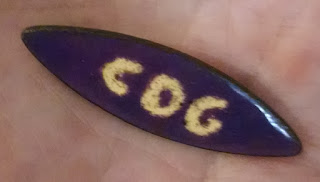
This enamel tie pin was in a small metal box with other old trinkets in my father's closet. I made it for him when I was in 8th grade. He was selling cars at the time.He was always meticulous about his appearance (or you could say vain), and had more fashionable tie clips, but I remember he did occasionally wear it. He was proud of our last name and his initials. In fact, if you bought one of our family's houses, it's quite possible you had to sandblast the fireplace to remove the letter "G."

I copied the above from my Facebook post, but a school memory has been triggered. In 8th grade I was "accelerated" in math and art. I'm not sure why those two subjects, and I don't know who decided. I like both, and I was good at math, but English strikes me as my "subject," especially at that time. My math experience was horrible. The teacher was an abomination. Today, he would be arrested, convicted and jailed. He'd be forever disgraced. I had him for both 8th and 9th grades and was assigned to his class again in 10th, but I told my guidance counselor I'd drop math entirely unless I was transferred out of his class. She was mostly inept, but she'd refused my request the year before, and she knew I was serious so she put me in a class with a competent teacher.

Donna was "accelerated" in art. I think that year we took the same two classes, enamel jewelry making and pottery. I don't remember there being any other students in enameling. I think it wasn't the teacher's passion - that was his photography class. Still, with few students, we were able to make a lot of jewelry. 

In pottery, the teacher freaked out after a couple of weeks, and was replaced by a young woman who was rigid. There were a lot of students in the class, because the teacher who freaked out was beloved, and basically allowed students to do, or not do, whatever they wanted. The class was bedlam after the new teacher took over; kids continued to do whatever they wanted, but now there was a teacher looming over the room, yelling constantly. This triggered Donna to act out, by becoming a vandal to the room and the other kids' projects when no one was looking (except me).

Tuesday, February 02, 2021

Warning, this post will be vulgar. The New York Times makes me feel like puking. Latest example...A front page story dissing the health department. As an outsider, I see it on a daily basis because of the "new normal:" The staff works 24/7 to contribute to the fight against the pandemic, and that snarky elitist scum J**** et al play "gotcha." I've never been a fan of its self-absorbed urban hipness POV; I remember once during a grad school presentation that I gave on Gould's Mismeasure of Man (for a class I now teach), I described the book as having been panned by the popular press (ie, the NYT), the (spacey, snotty) instructor interrupted me, all offended, to say, "the liberal intellectual press" and I shot back, "hardly, it's written for eighth grade reading level!" Years later, they were exposed for shoddiness when articles were written in Brooklyn that alleged to be eyewitness reporting from Iraq--complete with photo-shopped images! So not only are they grade 8 but unethical too. Well - the NY Times was once used to wipe asses in outhouses, and it still is used to train puppies, shredded to fill cat litter boxes, and line birdcages. In other words, it's only good for absorbing piss and shit.

Tuesday, October 22, 2019

Tuesday, November 24, 2015

I Don’t Have One

Fourth grade was the first time Gwen noticed Samantha. The year before, the girls’ school switched from dividing classes by hamlet where you lived to sorting kids into two sections, based on "ability." Prior to this, Gwen had been with her kindergarten peers for three years, while Sam’s kindergarten class had also been together, with different teachers for Grades 1 and 2. With the switch to tracking, they wound up in the same class, but she still wasn't on Gwen’s radar screen. Their fourth grade teacher, Miss Innis. changed that. Miss Innis was in her 30s but she seemed ancient. She was the definition of an old school marm: Hair in a bun, stiff, thin and bony, brittle, with plain attire that featured high collared shirts, buttoned up to her chin. Gwen thought she looked something like Olive Oyl. She wasn't particularly mean to either Gwen or Sam, but she wasn't nice either. She didn’t single kids out for ridicule as some teachers did; she was equal opportunity mean. The whole class was terrified of her.  

To illustrate sets in math, she told the fourth graders to get into groups if their houses had two or three or four bedrooms or what their fathers did for a living (worked for IBM or owned businesses or were teachers etc.). That day the question was about dad’s job. Sam didn’t go into a group and when Miss Innis asked why, responded "I don't have one." Sam was suddenly noticed by everyone in class, including Gwen.

The second time Gwen thought about Sam was during that same year in school. Just when the students were poised to leap from the flutofone to a "real" instrument, Miss Innis yelled out, "who's Catholic?" Gwen and a handful of other kids timidly raised their hands. Sam was Catholic, but her hand either wasn’t noticed by Miss Innis, or she was too scared to raise it at all. The brave souls who raised their hands were herded across the street to the church for religious instruction, and so missed instrumental music and were never able to be in band. Sam didn’t go across the street and didn’t miss music, but she also didn’t join the band until much later, in high school. The band was chosen to march in the Macy’s Thanksgiving Day parade one year, and Sam wanted to go. So she volunteered to play the cymbals, and once the trip was over, she quit the marching band.

Despite those two incidents in Grade 4, Gwen considered sixth grader to be the actual start of a friendship between them. It was facilitated by Gwen’s  “best" friend Amy, whom she’d met the first day of kindergarten. Amy had been put in the "other" section of class after Grade 2.  As a result of the scrambling, she became friends with some kids who lived near Sam. Sometimes Amy would be invited to the party of a girl in her class that Sam was also attending. They got to know each other, eventually Amy invited Sam to her house, and since Gwen and Amy were always together, all three girls became friends.

Once they knew each other better, Gwen found out that Samantha did, in fact, have a father. Sam’s parents divorced when she was six months old and he was remarried and lived four hours away. Why she said she didn’t have one when Miss Innis was clumsily trying to teach sets was a mystery. Did she not know what he did for a living? Was he a drunk who didn’t  work so it was easier to pretend he didn’t exist? The latter explanation didn’t occur to Gwen until years later.

Saturday, July 11, 2015

Bob was organizing a cabinet in the utility room and came across a treasure: A sweater that my mother knitted almost 45 years ago for our dog Pud. Here I am with Pud in about 1972 at a Bennett school fashion show, modeling a dress my mother made while Pud wears the sweater. After Pud died in 1986, the sweater was passed along to Penny Poodily and when she died in 1999, I must have stuck it in the cabinet. Rosie is my first dog since then who is small enough to wear it. It's still in like new condition and it fits her perfectly!


 "It's to hot to wear this sweater"

Friday, January 31, 2014

When I heard about this, it made me cringe. Not to dispute that there are better paying jobs, and more opportunity in applied fields than in the humanities, but why is it necessary to single out one field to be the butt of a crude joke? He might just as well have retold the quip that has the tired punchline "do you want fries with that?" Art history majors and art historians -- and by extension, the entire discipline of art history -- are an easy target, I guess.

Just yesterday I was talking to students about what I describe here (the "no offense" woman, not the student with the question). I have also been remembering recently that in high school, teachers warned us EVERY DAY that we would never get jobs because the economy was so bad. They never said, study the practical thing, or told us why we should love their subjects. Instead, PhDs were driving taxicabs in NYC, so we were doomed. The economy and generally pessimistic mood of the late '70s reminds me much of today.

So I studied what I loved, and did not give a thought to how I'd apply it. I have never had a regret about my humanities / social science liberal arts degree in history. It has served me very well, in fact, in preparing me to pursue graduate study, in honing my research and writing skills, in sparking a lifelong love of the field. I have never been unemployed, so there.

Thursday, November 21, 2013

I'll be traveling and so won't be around a computer for much of the day tomorrow -- and once I am, I won't be writing here. So to commemorate the 50th anniversary of JFK's assassination, I will link to this old post of mine, "Gym Teacher from H-ll."

Thursday, May 16, 2013

Today I am inspired to write about educational philosophy. I took the class I'm teaching this summer in 1998 when I was a doctoral student. At the time it was taught by two different faculty members, neither of whom are at the university any longer; one retired and the other went to greener pastures. One professor focused exclusively on the roots of the field: Greek philosophers, European Renaissance thinkers, with Dewey’s progressivism as the most modern approach covered. The other, and this is the class I took, addressed the subject from a feminist and socio-economic perspective. The Greeks, Europeans and even John Dewey were never mentioned.

When I was preparing to teach this class, I reviewed the syllabi of the faculty who have been teaching it more recently. For many years after the two professors I described moved on, an adjunct from another local college taught the class. He is no longer teaching it, but two other professors are. Two-thirds of the syllabi reflected the “roots” approach, while the remaining syllabus indicated “roots” plus a more modern approach.

I’ve been teaching educational philosophy as one of seven themes in my undergraduate foundations classes for years now. When I first tackled it, I (pretty much) had to learn the subject from scratch, as my own experience was not very helpful – whatever it was we studied, I knew it was not educational philosophy. I now devote about four weeks of the semester to the discipline, and have come to believe that it is the most important of the educational foundations.

Thursday, February 28, 2013

10,000 protesters are downtown today. Another example for toleration in a few weeks, when we cover political toleration and free speech. I think this was a serious miscalculation on the governor's part.

 Last night I was casting around for a (kindle) book to read. A friend had posted her short list of five books Americans should read. It consisted of My Antonia, The Grapes of Wrath, the Autobiography of Frederick Douglass, and the poems of Emily Dickinson and Gwendolyn Brooks. I don't have a problem with her list, but mine would have to include at least one by Mark Twain and maybe A Tree Grows in Brooklyn.

That musing got me thinking about John Steinbeck (as it happens, it was his birthday yesterday). My favorite book of his is not GoW but Winter of Our Discontent. I own it in paperback, and have read it more than once, but it has been many years since the last time. So I decided to get the kindle version, and I started it last night. I can already tell that I am going to thoroughly enjoy it once again. (And, I see some possibilities for the toleration midterm, which I have to write next week.) I even enjoyed the introduction, which is a surprise. One of the reasons I did not like English classes that focused on novels in high school and avoided them entirely in college is that I don't care to suffer through someone's interpretation of a work of art. I want to develop my own understanding. But I did glean a tidbit from the introduction that was news to me -- the setting was Long Island. I thought it was coastal New England, likely Massachusetts when I first read the book 30+ years ago.

 This has nothing to do with any of the above, but I couldn't stop myself:


Friday, November 02, 2012


Last night, inspired by this journaling exercise, I had student do a five minute free write on two prompts:

1) Recall a time from your own schooling when you felt especially included, engaged, appreciated, and validated
(2) Recall a situation when you felt especially excluded, alienated, and invalidated from school

Then I invited them to share, with "thank you" being the only class response permitted. This is my vision -- to the second prompt, obviously.

They discussed the free write with their groups before they shared with the whole class, and one comment about the group dialogue was that most of the stories were about elementary school even though feelings of alienation are common in college classes. They speculated, is it easier to reflect on something when time passes and distance has been achieved?

Thursday, July 26, 2012

A sense of melancholy arrives with August. Not because of the looming end of the growing season (since August is a month full of produce -- anticipated all year). Not because closing the pool is on the horizon. No, it's those back-to-school ads. From childhood I remember the annual August assault, although my feature that some say is a bug has kicked in* and I can't remember the specific retailers. (My heart is thumping with pride over the alliteration of that sentence.) I do remember the products in this instance -- school supplies and school clothes.

I haven't heard the ads for 2012 on the radio (I don't listen to the radio) or on television (I don't watch programs with commercials). This morning I received an email from a retailer I do remember (and often patronize)...amazon: "Back to school: Dorm and K-12 essentials."

The television and radio versions that I remember from childhood were a repetitious bombardment. Amazon emails don't annoy me in the same way, but the melancholy isn't caused by the tiresome nature of the ads anyway. No, it is the reminder of going back to school, the dread that evoked even for a good student.  Funny that I have chosen to live my adult life on the school schedule, with the workload of semester's end and depressing countdown to the first day of classes every academic year.

That surely seems lame when the charms of the schedule -- a winter break and a long, leisurely summer -- more than makes up for sleepless December and May and bittersweet August.

This morning's view from the kitchen window

*I can't perceive in any way -- hear, see or remember advertisemens unless they feature a cute animal and even then I don't usually remember the product or retailer afterwards.

Tuesday, May 08, 2012

Today is National Teacher Day, a holiday made up by someone. Hallmark? The NEA? Indeed, I ask the students in my foundations classes every semester to reflect on this -- although not just on being appreciative, also on less than stellar experiences. And so in that spirit, here's a link to my story, Seven Teachers.

Recently my sister commented that she had remarked (sadly) to her husband that if something happened to them, their six-year-old granddaughter would not remember much about them. He said she would -- until asked what he remembers from 1958? She's right, of course, but I am still amazed at the number of people who say they can remember very little of what went on in school, especially in the early grades. Some cannot even remember teachers' names, including those from high school. This is not the case for me. I always intended to add to Seven Teachers, considered it a work in progress. I haven't, and most likely won't. However I am going to try a little exercise -- a list of things I remember from each year.

Kindergarten, Mrs. M: It was half-day; I went in the morning. We lived across the road from the school. My brother drove me. On the first day, I couldn't wait to get inside; ran up the stairs without looking back. As the youngest, I wanted to go to school, just like my older sister and brothers. I had a kind teacher who my siblings also had; the was the only kindergarten teacher at that time. I met my best friend on the first day. She spent a lot of time sitting on the teacher's lap, crying. I remember the i.t.a. alphabet on the wall above the blackboard. Decorating another wall were cardboard shoe cut-outs with laces and our names. We didn't get a shoe on the wall until we'd learned to tie a bow. I excelled except at this task, and I recall the anxiety I felt about not having my shoe up there until I finally mastered tying my shoes.

Grade 1, Mrs. T: Again I remember liking the teacher, a woman who was also well-known to my family. It was not nearly as memorable a year as kindergarten, but I do have memories of reading i.t.a. books and writing stories using i.t.a. We started having gym class with Miss A, and she was mean. (This is elaborated on in both Seven Teachers and Gym Teacher from H-ll, although she isn't the main character.)

Grade 2, Mrs. H: I had a teacher worthy of teacher appreciation day; she's featured in Seven Teachers. I do remember we had ability groups that were pretty easy to identify by level; I am not sure this is best practice today. But with the i.t.a. transition, I don't believe she had a choice. I was sent to the Principal's office for the first (and only) time in my elementary school years, when Mrs. H was out of the room and Mrs. F, who taught the other second grade class, was watching us. Another girl punched me to get a brown crayon away from me, and we were both sent to the office. I remember the humiliation I felt, sitting there squirming while the secretaries made sarcastic remarks to me as I waited for my punishment. But the principal never spoke to me. Instead Mrs. H came and bailed me out. She said, "I knew you were not at fault and I'm sorry you got sent to the Principal's office." This was also my first year with the Gym Teacher from Hell (also featured in Seven Teachers). We moved from Boiceville to West Shokan and I was thrilled.

Grade 3, Mrs. C and Mr. B: The ability groups issue became less obvious, because the school switched to tracking in this grade. Prior to this, I had been with my kindergarten peers for three years, while the afternoon kindergarten class had also been together, with different teachers for Grades 1 and 2. For grade 3 they sorted us into two sections, based on "ability." Both classes had the same teachers, one in the morning and the other in the afternoon. Mrs. C taught math and social studies; Mr. B taught English and science. I liked Mrs. C a lot, but Mr. B not so much. He also  has earned a spot in Seven Teachers. In math that year I remember timed tests for the times tables, and how many kids freaked out over them. It did seem cruel and anxiety-producing, but today I am thankful I learned the multiply in my head. I also remember Mrs. C cut her hand cooking Thanksgiving dinner and was out for weeks, because she needed surgery to repair the tendon.

Grade 4, Miss I and Mr. D: Miss I is another teacher featured in Seven Teachers, and not for the appreciation reason. About Mr. D, I remember he was a gentle teacher who must have had affection for geography. I recall making relief maps with paper mache. It is during this year that I have my first memory of my "difficult" friend. She had been put into my class in Grade 3, but she wasn't on my radar screen. Miss I was trying to illustrate sets in math -- asked us to get into groups if our houses had 2 or 3 or 4 bedrooms or our fathers worked at IBM or owned businesses or were a teacher etc. My friend did not go into a group and when asked why, responded "I don't have a father." It stuck with me.

Grades 5 and 6, Mrs. V and Mr. H: Mrs. V taught fifth grade in the morning, and sixth grade in the afternoon. Mr. H taught sixth grade in the morning, and fifth grade in the afternoon. So we had them for two years, and the other section had two different teachers over the two years. Both were quite influential in terms of learning -- the two year stretch may have been the reason. I liked both of these grades and teachers, Mrs. V in particular. I liked math and English especially, and each teacher taught one of those. I wasn't crazy about science, but she must have been a good teacher because I don't remember being repelled by the subject, as I was in Grade 3 with the weird Mr. B. Although I didn't have this problem and I liked him a lot, now I know that there was too much singling out of students in Mr. H's class, and even then it made me uncomfortable.

Two memories from Grade 6: 1) it was the presidential election, and Mr. H and one student (the son of our music teacher, and sadly, this student was killed in an alcohol-related accident senior year) supported McGovern. Everyone else in class supported Nixon. 2) I consider this year to be the actual start of a friendship with my troubled friend. It was facilitated by my "best" friend -- the one I'd met the first day of kindergarten, who had been put in the "other" section of class after Grade 2. Before grade 2, we were sorted by the hamlet we lived in, rather than tracked. As a result of the scrambling, she became friends with some kids who lived near this other girl who was now in my class. Sometimes my "best" friend would be invited to the party of a kid in her class that this girl from my class was also attending. They got to know each other, and the three of us slowly became friends.

Grade 7: This marked the beginning of junior high. I remember I couldn't wait to get out of elementary school, but I also remember it turned out to be a disappointment. My goat, Heidi, died right before the school year started, which erased my excitement. We changed classes. Gym was better; I had a teacher who was on the verge of retirement who was a heavy drinker, and she stayed in her office and didn't care what we were (not) doing. Of course I didn't become a jock, and in subsequent years when I did have to make some effort, I still didn't like it, even though I had an occasional competent teacher (and one who was a little too flirty with the popular girls). I had to take general music, which was taught using the Socratic Method. I did fine, but it was terrifying. Mrs. or Ms. (not sure which) H, the science teacher was young, green, and obsessed with discipline. (She is not one of the Seven Teachers, but she is briefly mentioned in the opening, and also here. We took home economics; no fault of the teacher, but that was pretty much a waste of time. I wrote a paper about one-room schools for my seventh grade social studies project on local history - a harbinger of things to come?

Grade 8: I was placed in accelerated math and art. Neither turned into a great experience, in both cases it was the fault of the teacher, but for whatever reason I did not include them in Seven Teachers. The art teacher is mentioned here. About the math class, Mr. C was possibly the worst (academic) teacher I have ever had in my life. Another Mr. H teaching social studies, with a few choice memories from his class. I recall him sneering at me about status symbols because of my parents' car; I remember his stepson was a friend of my brother's and he told us stories about how they didn't get along; I remember an obnoxious guy who sat behind me snapping my bra strap; I remember another obnoxious guy opening the door of our class and yelling "guinea guinea wop wop" at me. My "best" friend moved away at the end of the year. This was very traumatic for both of us, and led to my budding friendship with the other girl going into full bloom, with mostly negative consequences (for me). At the end of this year, the Traver Hollow Bridge, which connects West Shokan to Boiceville, was closed and our bus had to go around the Reservoir to Shokan to get us back and forth to school. This situation continued almost until I graduated. I am not a lark now, and was not a lark then; I missed the bus often.

Grade 9: I landed the same teacher for math as the year before, the school refused to change my placement and I suffered another year. In social studies, I remember Mr. W liked anthropology, and tolerated rampant cheating. I started taking Spanish, and loved it. I took physics, and hated it. Not because of the subject matter, which I found interesting, because the teacher was a blowhard.

Grade 10: Social Studies also stands out -- I must have been tracked into a class that was not the top one, and this continued in eleventh grade. In both cases, the atmosphere was bedlam. I did like my tenth grade social studies teacher, he was an amiable guy. One time he said to some kids in the cafeteria, "you should all be smiling like she is," indicating me. I responded, "I may be smiling but you have no idea what I'm thinking" and he laughed. Once again, I got the same teacher for math as I'd had in eighth and ninth grades, but this time the guidance counselor moved me when I told her I would drop math entirely if she didn't, since only a year was required to graduate high school at that time.  So, for the next two years I had a math teacher who was strict, but very skilled. I spent a lot of time in many classes doing monotonous homework assignments for the next class rather than paying attention. We were permitted to take English selectives -- this and art were the two bright spots. I started taking extra classes rather than study halls. At the end of the year, I was recommended for a year of study in Mexico because of my performance in Spanish class. I thought about it and declined. The teacher, Mr. W, asked me if it was my parents' decision? I said no, it was mine. (And it was; they thought I should accept.) I wanted to go to college, not come back for another year of high school.

Grade 11: I wrote for the school newspaper and continued enjoying English selectives, although one teacher really stands out, Ms. S -- she taught writing -- and I wrote about her in Seven Teachers. I loved her classes. The others, who taught reading courses, did not strike me then or now as having any special insight into classic novels (another of the selectives teachers is also one of the Seven). The same is true for social studies; I remember being forced to rewrite a review of a Maya Angelou book that I'd written not because it had errors or did not meet guidelines, but because he did not agree with my take on the reading. I continued doubling up on classes. My friend's life went from bad to worse and she moved in with us in November of that year. By June, I had enough credits to achieve my goal: graduating and getting the h-ll out of there. At this point I had to go -- for academic and social reasons. My parents visited the school to be sure it was a good idea -- I was only 16 -- and the administrators said they believed it was. They had nothing to offer me.

Thursday, December 08, 2011

Eggplant is my favorite food. Thinking back,  I realized this past week I had:
  • eggplant napolean at The Point in Albany for dinner on Wednesday of last week (it was divine), 
  • eggplant napolean from the Outtakes store on campus on Thursday for lunch (it was acceptable, even tasty. I suspect slabs were packaged up the day after it didn't sell out at the Patroon Room lunch buffet -- sort of reminds me of elementary school when an apple was the snack and kids would take maybe one bite, then go up to throw out the tray. A lunch aide was always there, grabbing the trays full of trash. Next day, 1/2 apples were the snacks. Hmmm),
  • eggplant parmesan from Scarnato's in Castleton on Friday (it was to die for, my favorite, best anywhere, no contest, A+++, rivals my own or even Ma's),
  • frozen Celentano eggplant for dinner on Saturday (it was not that good),
  • eggplant and white bean soup for brunch at the Chatham House on Sunday (it was heavenly),
  • eggplant parmesan at Teagan's in Rensselaer on Tuesday for dinner (it was serviceable).
What? A week with only six days of eggplant? How can that be?


Something I don't do as much as I'd like is cook time-intensive, more complicated dishes. Some of my favorite things to make involve pie crust (with apple pie topping the list!). Today I decided to make a quiche. It's been ages since I made one. My recipe: pie crust (1 1/4 c. flour, 1/4 t salt, 1/3 cup butter, 4 T water), roll out into one crust, put in pan, line with foil and bake 450 degrees for 8 minutes, remove foil and bake 5 more minutes. Filling (4 eggs, 1 1/2 c milk, 1/4 t salt, 1/4 t nutmeg, 1/8 t pepper, 1 t minced garlic, 8 oz shredded cheddar cheese, 2 c chopped spinach). Bake 325 degrees for one hour. 


Today is another day without eggplant. (Already know I'm having it tomorrow though.)

Monday, November 28, 2011

Spent today in school. Observing third grade this fall -- ten different classes, two different schools -- is bringing back so many memories of my own experiences in that grade 42 years ago. The teacher described here in my Seven Teachers anecdote as "Maybe He Thought Third Graders Liked Gross Stuff" almost sums it up. The other half of the day I had a wonderful teacher, and (in what may be a commentary on what is remembered -- the bad more than the good) not a lot of specific memories.

I do have two. First, the teacher cut her hand badly preparing Thanksgiving dinner, had to have surgery to repair the damage to her ligament, and was out of school for (what seemed to an 8 year old to be) a long time. Second, it was during third grade that we learned the times tables. Luckily, it was the wonderful teacher, not the lover of disgusting lesson plans who taught math. But I remember we had to memorize each number sequentially, and then pass a series of progressively faster timed tests.

At the end of each - 9 minutes, 5 minutes, 3 minutes, as I recall -- we got certificates with gold seals and ribbons. This exercise was a great source of anxiety (and in many cases failure) for a large number of fellow students, although also luckily, not for me. I know the method gets a lot of criticism and has been abandoned in more places than not, but today I am thrilled to have that invaluable information cemented in my brain.

Wednesday, November 09, 2011

I have been scanning ephemera into efiles, and sharing them on facebook. I have a lot of cousins who are hungry for the photos and memorabilia. While looking to see what else I have that I'd already scanned in the past, pre-facebook, I discovered my old writing folder tucked away, several levels down from the desktop. I must have backed up the Iomega drive at some point! Oh happy day!

After I read the story I have copied below, it reminded me of something else from yesterday, also friend-related. I am handling the retirement party for someone at work that I have known since I was in the doctoral program, and yesterday it hit me that I need to get a card so colleagues can sign it. The clock is ticking! I went to the bookstore to buy one. There were only two choices for retirement. I laughed, shook my head, and chose the one with the most space for signatures.

I was thinking how I always fly by the seat of my pants -- get out of bed with five minutes to shower and get ready. But especially on such things as cards, gifts and gift wrap. No time or space to hit a Hallmark store. Bob is our designated gift wrapper, left to me I roll packages in crumpled funny sheets and use masking tape. I am capable of making pretty presents, but I almost never do. Reminds me too of Aunt Jean. She was always scribbling out the message on cards - changing Get Well to Happy Birthday. So when I ran across flying by the seat of my pants in this anecdote, I had to smile.

What's Missing from this Study? (1998)

This fall marks my thirty-first year of being a student.  The plan is to graduate after two more academic years and be done, having attained the ultimate terminal degree, the doctorate. 

It will not be too soon.  A good part of my identity has been defined by my student role.  It has fit, or I wouldn't have worn it so long.  It feels good to excel at something.  To have almost no peers, even among my student peers.  Feed that special trip.  It has always been this way, which is why high school wasn't any fun.  High school, where so much is defined by the social life, the cliques and clubs and teams.  That part doesn't matter so much any more.  Now it's great to be smart.

So why will it not be too soon to put aside the student role, since it fits like a glove?  The costume is too tight.  Two three hour sessions for two consecutive Saturdays writing to fulfill a requirement.  Answer eight questions out of sixteen. Spend an equal amount of time on each response.  Be sure to really answer the questions. Go.

Fifteen more three hour blocks, Monday nights from seven to ten, to prod along those (shift around nervously) dissertation proposals (pause for a moment of shared giggles and groans).  In a three hour block of time I could read a book or write a story or take a walk or stare into space.  Instead I must sit at yet another conference table and listen to one more meaningless comment. Yes, class, yes professor X, believe it or not there are stupid questions.  My special trip has made me feel superior, how awful.  Makes me long for RB's class, a sweet memory from my undergraduate days.  "Raise your hand if you are a freshman," he would say, immediately upon walking into the room on the first day of class.  (Looks around room.)  "I have signed drop forms on the table in the front.  You're out of the class."  (He's not joking.)

 Recently I read some publications from high school.  Been digging out every scrap of my old writing.  "Monday Blues" was our literary magazine. A greaser girl named Teresa wrote a story called "Where Did Freedom Go."  The premise of the essay was that it's unfair students couldn't go to the market across the street to get a soda, and they shouldn't have to go outside to smoke cigarettes.  I remember reading it at the time and thinking it was hilarious.  But Teresa didn't intend it as a humor story.  Now I feel as confined as she did.

But these are doctoral students, not teenage greasers.  Are there any former greasers in the group?  More likely jocks, maybe even the top magazine-selling booster club member.  Mostly they pass the class time by studying for the comprehensive exams, unabashed.  No RB here. I remember years ago my friend Stefan said that there are something like only twelve different facial types, and everyone has a twin.  Jeff from my class (does he have a topic?) is a triplet. (He's the grad student triplet.)  The other two are Paul from work (the accountant triplet) and Gene, a.k.a. the Corvair driving, gun toting, employed by and worshipper of the governor (the evil triplet). Jeff tells the class he has asked Professor D to be his dissertation chair (God help him) but hasn't gotten a commitment. Sitting in the back, a man I don't know asks trivial questions, things about font sizes and format.  But maybe that's actually insightful and not inane, since senior management would value such interests.

Laura and a man I don't know discuss how they didn't finish the management section and never planned to pass it. (And I thought I was flying by the seat of my pants.)  The woman next to me, a music teacher whose name I can't, but should, remember, sits frozen, on automatic pilot until the second half of the comps are over. But I know she always does her school work, so how bad can it be? No, I guess the questions weren't written as a musical score.

Debbie tells a story about parents pushing kids too much, especially in sports -- something alien to her, since she was always somewhere else smoking cigarettes when there was a high school football game.  So there is a former greaser among us!  The others, including the instructor, stare in disbelief. I find her story hilarious.  This time, it was intended to be.

Thursday, October 27, 2011

Wow - it feels like snow!

Which reminds me, Elwyn wrote in his diary that the return to "real time" took place on September 30 in 1951. I looked it up and we are not falling behind until November 6! I remember not that long ago it was much earlier in the fall; you don't have to go back 60 years. I don't care if it is dark at 2 PM - I hate getting up in the dark. It feels like it is the middle of the night when the alarm goes off.

I thought the reason for this stupidity was so that kids don't have to wait for the school bus in the dark in the spring. That is what is always said when moving daylight savings time to earlier in the year is questioned. Hello! They are waiting for the school bus in the dark right now.

I want my hour back now!

On another subject, sort of related only because someone in government decreed it, the subject of the metric system came up recently when we were visiting a friend. We all remembered lengthy units every year in elementary school where we learned it. We were told that we were going to convert to it someday and that was why it was important. We were scolded that it was a better, more sensible system that the rest of the world used when we complained. The insinuation was that only provincial morons who were stuck in the past would resist.

Well, guess what? It was a failure and we never switched. All that instruction was a waste of time. What makes it worse is that we never learned anything about the supposedly inferior system we use every day - acres, miles, quarts and bushels were completely neglected. That information had to be taught to us by our parents. Today I know people who struggle with how many pints are in a quart.

Who couldn't have predicted that outcome? I feel it was culturally insensitive to teach us that crap and ignore the English system.

Thursday, August 25, 2011

So much work so little time! Irene is not even on my radar screen, I am so preoccupied by the semester starting. But, I am accomplishing a lot, and doing OK. Always feels good to be super productive, even if it makes my head numb! Many details for the semester are finished, and my study is really coming along! I wanted to write an ethnography for my dissertation, but stayed with a practical program evaluation, since I was quite far along when my interest in it waned. (Because a wise mentor told me, "the only good dissertation is a done dissertation.") So now I am writing a program evaluation that is an ethnography and loving it!

My five-year-old grandniece is starting kindergarten. She's beyond excited. She's a little miracle, and not only because all kids are precious, but because of the circumstances of her birth. It's not my story to share, and so I won't. But that she is vibrant in every way is something for which we are all very thankful. She's bright - surely she will be the smartest kid in her class, healthy (the true miracle), well-behaved and good natured - and this isn't just her doting great aunt opinion's. Everyone who perceives her "mesmerizing" eyes notices. (That was the word used by a friend who has never met her, trying to describe her while gazing into her picture.)

I will see her Labor Day weekend and cannot wait to discuss it with her. My own memories of starting school are swirling around in my brain. I met my lifelong best friend the first day of kindergarten. It's true, we've been friends for 50 years, and have stayed in touch all that time. Our friendship has never wavered or died out, despite our lives being very different (but we were not that similar back then either) and we have lived about 5 hours away from each other since age 14. I'm thinking of her today because she is bringing her daughter to college for her sophomore year tomorrow, and we had toyed with the idea of getting together. But we've not confirmed it, and so I am thinking it won't happen. Her life is in the "it's complicated" category right now so a rain check might be necessary, due to Irene and other factors.

Thursday, August 18, 2011

What a beautiful night it was for the food festival, and Eddie Money was great! One thing that was funny, though - he said he grew up in Greene County, in a town called Phoenicia! LOL! If it was Phoenicia, that doesn't speak well of my alma mater's teaching of local geography. (But if we blame elementary school rather than junior or senior high, at least it wasn't the one I attended.) If it was Greene County...not my district.

I actually do remember learning geography in school, but nothing local; it was only the capital cities of other countries. I don't remember what grade that was, but I do remember the teacher was male. It was a memorization exercise in social studies, and he used one of those wonderful visualization tricks for remembering things: one example, he said picture a turkey with an anchor around its neck, and so I still remember Ankara, Turkey.

Yikes. 

Added: Really good column this week! 

And: I've written here that the container tomatoes are huge, but a picture is worth a thousand words in this case.